
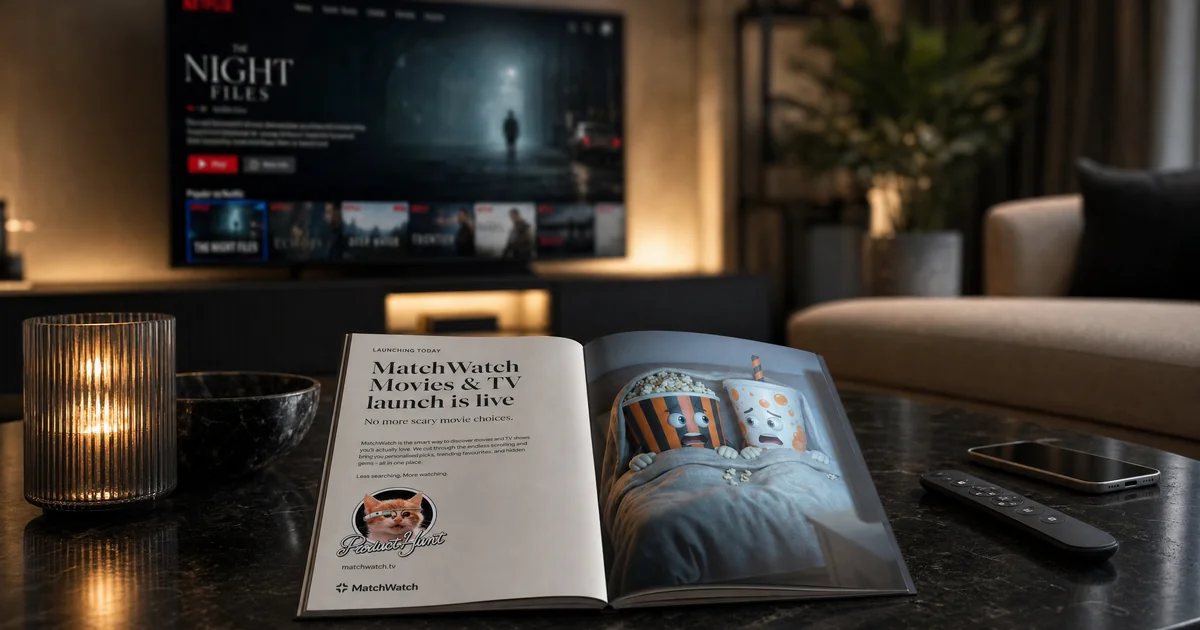
On a late-autumn Thursday in Hamilton, MatchWatch went onto Product Hunt while the rest of the city looked for the heater remote. This retrospective explains what the MatchWatch Product Hunt launch put in front of people, what has changed since and what we learnt by showing the work. On 30 April 2026, the app had to make sense to people who did not already know the problem or why a household might need both private swipes and a shared answer.
What did MatchWatch launch on Product Hunt?
The MatchWatch launch page on Product Hunt showed a working web app for couples, families and flatmates who could agree that they wanted to watch something, then spend forty minutes proving the agreement went no further. It gave us a useful place to explain the product to people arriving without any context or polite obligation to understand it.
The central idea was deliberately small. Each person gets their own deck, makes private yes-or-no choices, and sees a title become a group match when enough people like it. That is easier to understand in the lounge than in a product description. One person can quietly approve the serious drama. Another can admit they would rather watch a comedy. Nobody has to deliver a closing argument over cold tea.
The problem stayed ordinary
Launching on a technology site can tempt a product into sounding grander than the thing it fixes. MatchWatch does not reorganise entertainment or decide what good taste looks like. It helps a real group find the bit where its separate tastes overlap. The problem is six paid services, four opinions and somebody eventually putting Shortland Street on because at least it has already started.
That plain problem still shapes the product. The article on how MatchWatch works explains the full path from account setup to a shared match. The shorter version is this: Apple, Google and email sign-in get each person into their own account, service choices keep the deck relevant, and private decisions stop the loudest person turning every title into a referendum.
What the app does now
The current app keeps the same foundation and fills in the practical gaps around it. Groups can include up to six people. Each member receives a personalised deck, and titles liked by somebody else can be injected into another member's deck so possible overlap has another chance to appear. The person who liked it is not announced. A useful coincidence should not arrive with cross-examination rights.
For two people, a match needs both yeses. In groups of three or more, the threshold is automatically set at roughly 60 percent, which keeps agreement meaningful without giving one person a permanent veto over the flat. There is no switch for the group to tune that number. It is a product rule, not an extra decision waiting in settings.
Fourteen mood filters help narrow the discovery deck before anyone starts swiping. They cover the kind of night the group is actually having, not the aspirational version where everybody is alert enough for a dense three-hour drama. The MatchWatch mood filter guide explains when to use them, while the New Zealand services overview helps keep the available pool tied to subscriptions the household really has.
The picker handles the final bit
A growing match list creates a better problem, but it is still a problem. Pick For Tonight chooses an eligible saved title, sends the group a for-tonight nudge and closes after the result. It does not mark the title as Watching for you. That remains a group decision, because starting a show on behalf of six people would be efficient in the same way changing everyone's tea order is efficient.
The Pick For Tonight walkthrough covers the tool without pretending random choice replaces taste. It comes after the group has done the useful work and found acceptable matches. The picker settles which approved option gets the evening, rather than pulling an unsuitable title from the entire catalogue and hoping confidence carries it through.
What the launch was actually for
The Product Hunt page was a point in time, not a permanent campaign. Putting the explanation in front of strangers showed us where it needed plainer language and which product details mattered without a guided tour. The useful lesson lasted longer than launch day: if the idea cannot stand on its own, a leaderboard will not rescue it.
What remains useful is the discipline of the exercise. If somebody cannot tell why the product exists after one short explanation, another paragraph of feature names will not save it. MatchWatch is for the moment when several people want one thing to watch and none of them should have to win the room to get there.
Where MatchWatch goes from here
The work after a launch is less photogenic. Provider information needs to stay current. Recommendations need to remain useful as catalogues move. Group behaviour has to feel fair when two people become six. Account access, saved titles and the small decisions around them all have to work on the wet Wednesday when nobody is interested in the product story and everybody is interested in pressing play.
For the practical side, the guide to stopping the watch-night argument is a better next read than launch history. It starts in the lounge and keeps the focus there. That is where MatchWatch has to earn its place, somewhere between the Maccas bag on the table and the person insisting they genuinely do not mind.
The MatchWatch Product Hunt launch was one public marker for a product that is still being polished, checked and made easier to use. The date matters as history, not urgency. The useful bit is still the same: separate choices, shared matches and less time spent browsing every service in the house. Available in New Zealand, Australia, the UK, and the United States.