
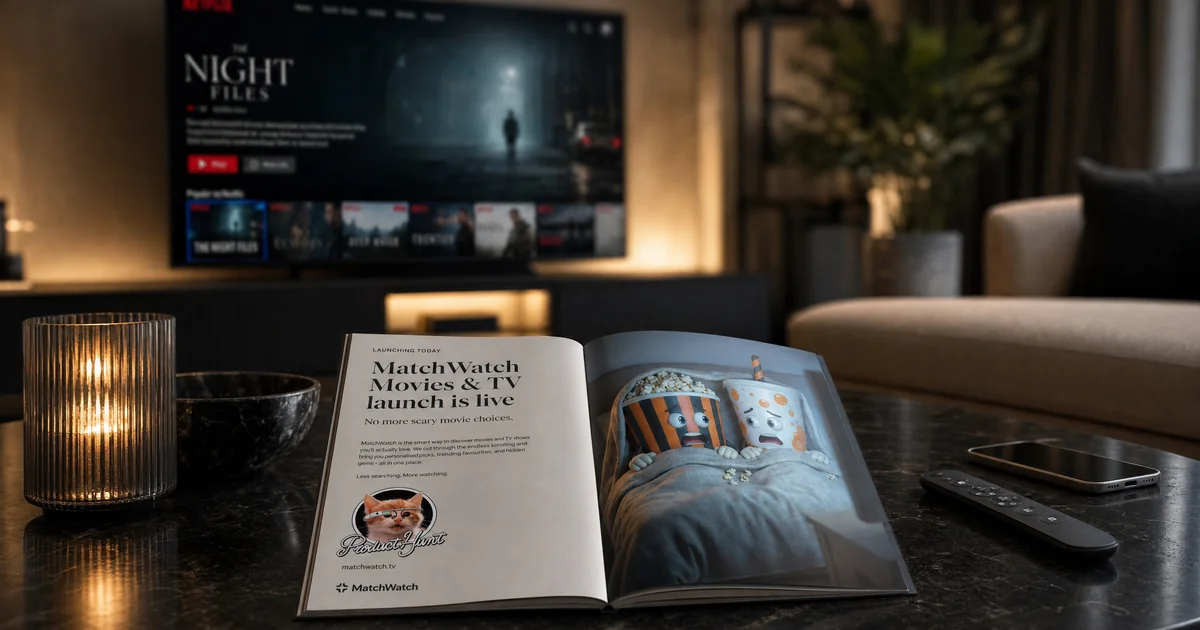
On 30 April 2026, MatchWatch appeared on Product Hunt beside a morning's worth of new products and had one page to explain itself. This account of MatchWatch on Product Hunt covers what launched, what the app does now and which decisions survived contact with people who had no reason to understand it. The pitch had to work without a guided tour, a friendly introduction or somebody nearby translating every button.
What launched on Product Hunt?
The official MatchWatch page on Product Hunt introduced a working web app for couples, families, housemates and friends who want one thing to watch without turning every suggestion into a debate. Each person chooses privately. MatchWatch reveals the titles with enough shared support. The idea was deliberately ordinary: several people, several tastes, one lounge and a takeaway that would benefit from a decision before it goes cold.
A launch page removes the usual excuses. There is no room for a long explanation of why the problem is more complicated than it looks. Somebody arriving cold needs to understand that MatchWatch helps a group decide what to watch, rather than playing a show in sync or reviewing the entire streaming catalogue. If that distinction takes five paragraphs, the fifth paragraph is not the problem.
The problem stayed stubbornly normal
Australian households can have Netflix, Stan, Disney+, Prime Video, Apple TV, HBO Max, BINGE and several free local services within reach. More choice does not create more agreement. It creates more menus. One person opens Stan, another remembers something on SBS On Demand, and a third suggests checking Netflix once more in case the first nine rows have changed since dinner.
The Australian streaming services guide shows the current local mix. MatchWatch sits above those services and keeps the discovery deck tied to the ones a household can actually open. The product does not need to decide what counts as good taste. It needs to find the titles that survive several private opinions and still exist on the services already being paid for.
What does MatchWatch do now?
Account access is now part of the setup. You can sign in with Apple, Google or email, then return to the same service choices, swipes, group and matches later. The Australian guide to how MatchWatch works covers the full path. The short version is that each person has their own account and their own screen, so private choices stay private until they contribute to a match.
The current MatchWatch interface and setup flow are designed around six people at most. That describes the product shown today, not a claim that the backend has a permanent capacity of six. It is enough room for a couple, a family, a share house or the friends who have arrived for movie night and immediately developed six different definitions of something easy.
For two people, a match needs two yeses. Groups of three or more use a default threshold of 60 per cent, rounded up. Three people need two yeses; six people need four. There is no group control for changing that threshold. The rule gives a larger room a meaningful majority without letting one determined holdout turn every Saturday night into another round of nominations.
The deck now starts closer to the right night
The discovery deck has 14 mood filters: Trending, Date Night, Action, Funny, Scary, Romance, Feel Good, Thriller, Kids, Family, Documentary, Sci-Fi, TV and Coming Soon. The Australian mood-filter guide explains how each one narrows the pool before anybody starts choosing. A Brisbane summer evening and a wet Melbourne Sunday are allowed to want different things from the same household.
Service choices and moods solve different parts of the problem. Services remove titles the household cannot open. Moods remove titles that do not fit tonight. Private swipes then record actual taste rather than the answer somebody gives while five people stare at them. The useful result is not a larger catalogue. It is a smaller, more honest set of possibilities.
Pick For Tonight handles the last decision
A healthy match list can produce its own smaller argument. Pick For Tonight chooses from eligible saved matches, sends online for-tonight nudges to the group and then closes. It does not mark the title as Watching. Pressing play remains a real-world decision, because software announcing that six people have started a show while two are still looking for the remote would be efficient only on paper.
The picker is a stopping rule, not a replacement for taste. Every eligible option has already earned enough support to become a match. Pick For Tonight settles which approved title gets the evening, then gets out of the way. That matters because opening one more streaming home screen after the group has already agreed is how a solved problem quietly returns wearing a different thumbnail.
MatchWatch is now on the App Store and Google Play
MatchWatch already worked on phones through its responsive web app and installable progressive web app. It is now also available as an iPhone and iPad download through the Australian App Store and as an Android download through Google Play. The Australian getting-started guide covers each route. Sign in with Apple, Google or email to return to the same account, group and matches across supported devices.
That web-first shape also suits the invitation problem. A group can move from a shared link into the same product without everybody stopping to prepare their phone first. Once signed in, each person can return to the group later. Movie night rarely begins as an organised software rollout. It begins when somebody says they are happy with anything and then rejects the first four suggestions.
What actually changed after the launch?
The Product Hunt page remains a point in time. The useful part was not treating that day as a finish line. Putting MatchWatch in front of people without context made the explanation stricter: what problem does it solve, what happens after a swipe, and why does a group need private choices before a shared answer? A leaderboard could not answer those questions on the product's behalf.
The work afterwards has been less tidy and more valuable. Account access had to support returning people. Regional service choices had to reflect where the household actually lives. Matching rules had to remain fair as a pair became a larger group. Mood filters and the final picker had to remove decisions rather than add another layer of settings for somebody to manage.
MatchWatch on Product Hunt was the public marker on 30 April 2026. What changed afterwards was the practical product around the same small idea: separate choices, shared matches and less time spent reopening every service in the house. The launch story matters because it shows what stayed simple while the app became more useful. Available in New Zealand, Australia, the UK, and the United States.