
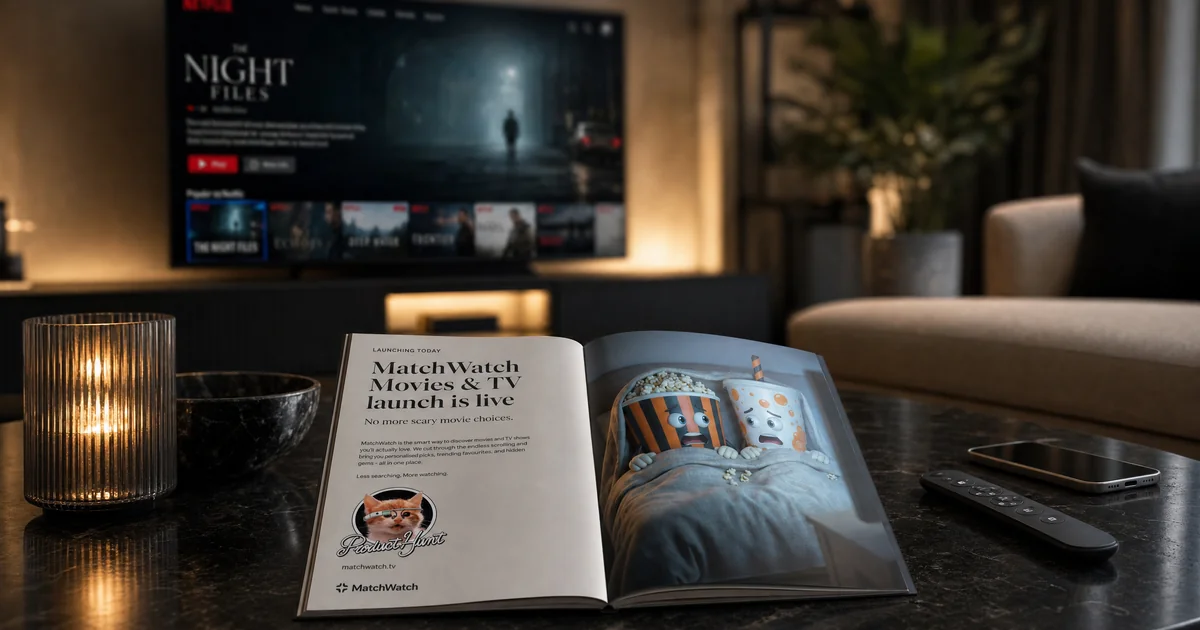
The launch page was live, the screenshots were public and strangers had no reason to fill in any gaps for us. This retrospective of MatchWatch on Product Hunt explains what went in front of people, what the app does now and what we learnt from making the idea stand on its own. On 30 April 2026, a familiar couch problem had to make sense without a friend nearby to provide the missing paragraph.
What did the MatchWatch Product Hunt launch show?
The official MatchWatch page on Product Hunt presented a web app for couples, families and roommates who want one thing to watch without turning every title into a debate. Each person makes private choices from movies and shows tied to the streaming services they already have. When enough of those choices overlap, the group gets a match.
That was the useful test of the launch. The product could not lean on a guided tour or assume the reader already knew why choosing together is different from choosing alone. It had to explain the ordinary moment: Netflix is open, Hulu has another list, somebody has checked HBO Max and the takeout is cooling while everyone waits for somebody else to decide.
The problem stayed deliberately ordinary
A technology launch can make a modest problem sound as if it requires a white paper and a new category of human behaviour. This one does not. Streaming catalogues are built to show what is available. They do not know which movie the people on your couch would all accept tonight, and opening another service rarely improves the discussion.
MatchWatch keeps those opinions separate until there is something worth sharing. The article on how MatchWatch works follows the full path from sign-in to a match. Apple, Google and email account sign-in options give each person their own choices, while the selected US services keep the deck tied to what the household can actually open. Nobody has to pitch a serious drama like a candidate at a town hall meeting.
What does MatchWatch do now?
MatchWatch is available on the web, iPhone, iPad and Android. The US getting-started guide covers setup on each route, including the progressive web app for people who prefer a browser. The useful part is unchanged: each person gets a private deck, makes a real choice and sees only the overlap that clears the group rule.
The current group setup is designed for up to six people. That describes the current interface and setup flow, not a hard capacity promise. One person creates the group and shares the invite. Everyone else signs in before joining, then swipes on their own screen rather than handing the remote around like a ceremonial object.
How does agreement work when the couch gets crowded?
For two people, a title needs both yeses. With three or more, the default match count is 60 per cent of the current group, rounded up. That means two of three, three of four, three of five and four of six. The arithmetic stays in the product, where it belongs, and gives the room a predictable default.
The rule does not decide whether a movie suits the children, fits the time left in the evening or still appears on the named provider. Those checks remain with the people watching. It settles one narrower question: did enough separate people already say yes? That turns a broad catalogue into a shared shortlist without asking the loudest person to chair the meeting.
Moods narrow the deck before the swiping starts
The current app has fourteen mood filters: Trending, Date Night, Action, Funny, Scary, Romance, Feel Good, Thriller, Kids, Family, Documentary, Sci-Fi, TV and Coming Soon. They describe the kind of evening the group is having before individual titles appear. A Tuesday that needs Funny should not have to inspect every three-hour historical drama first.
The guide to MatchWatch mood filters explains what each lane changes. The US streaming services overview handles the other practical boundary: which subscriptions belong in the deck. Mood and service choices do not create agreement on their own. They stop irrelevant options using up the room's patience before the real choices begin.
Pick For Tonight closes the final loop
A healthy list of matches can produce a smaller version of the original problem. Pick For Tonight makes a weighted draw from eligible shared matches. When the person running it is online and confirms the result, MatchWatch sends For Tonight nudges to the other people in the group, then closes the picker. It does not mark the title as Watching.
That last detail matters. A notification says what the group picked; it does not claim that the opening credits have started. The Pick For Tonight walkthrough covers the current flow and the separate watchlist update. Software should not announce that everyone is watching a movie while half the couch is still finding the right HDMI input.
What did putting MatchWatch on Product Hunt change?
The Product Hunt page is now a dated marker, not an instruction to recreate launch day. Its lasting value was the demand for a short explanation that worked outside our own context. Feature names are easy to collect. A clear account of the problem, the group rule and the shared result is harder, and much more useful.
The central idea survived because it stayed small. People choose privately. Matches reveal the overlap. Mood filters and Pick For Tonight deal with the two useful edges around that idea, first narrowing the deck and then settling the final choice. Everything else has to justify itself by helping a real household get something on screen.
Where the launch story sits now
The MatchWatch Product Hunt launch happened on 30 April 2026, and the product has continued moving since. The date belongs to the history. The current promise is more practical: separate choices, predictable group matches and a clear last step when several good options survive. Available in New Zealand, Australia, the UK, and the United States.